Kerameon 17, 10436 Athens
210-5231126 210-5223039
sales@hasioti.gr

Electronic Expansion Valves (EXV) vs. Mechanical Thermostatic Expansion Valves (TXV)

Proper regulation of refrigerant flow in a refrigeration or air-conditioning system is fundamental for system operation, performance, and energy efficiency. The Electronic Expansion Valve (EEV or EXV) and the Mechanical Thermostatic Expansion Valve (TXV) are the two most widely used technologies for controlling refrigerant expansion. Although both are commonly used to regulate refrigerant flow, they differ in their operating principles and applications. Let’s examine in detail their key differences, advantages and disadvantages, as well as best practice selection based on the specific application.

Mechanical Thermostatic Expansion Valves (TXV)

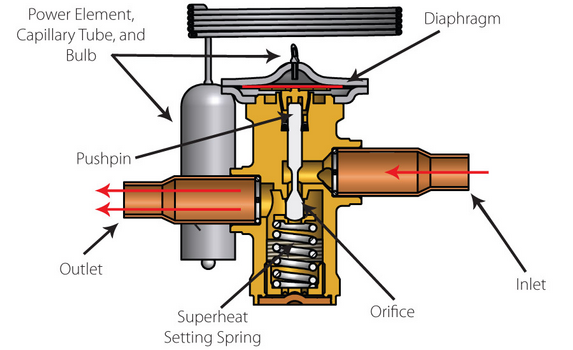
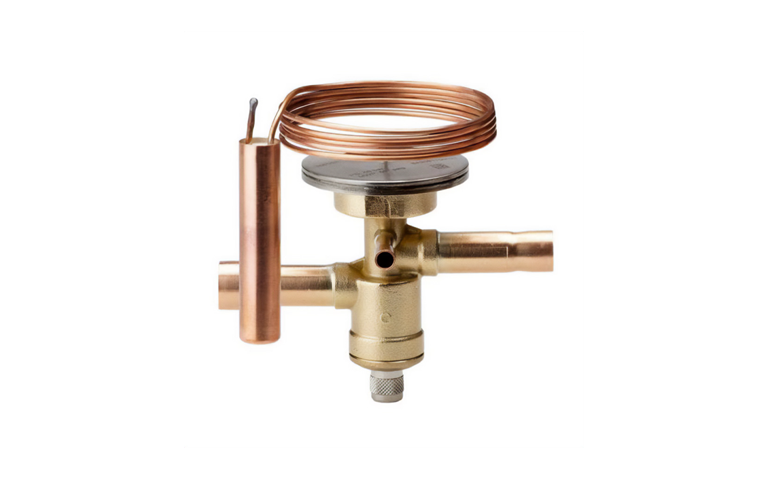
Mechanical Thermostatic Expansion Valves (TXV) are mechanical devices that have been used for decades in air-conditioning and refrigeration to control refrigerant expansion. The basic operating principle of the TXV is that it regulates the amount of refrigerant entering the evaporator based on the temperature measured by the evaporator’s temperature sensor.

Operating Principle:

•  The TXV features a temperature sensor (typically installed at the evaporator outlet) that influences system pressure through a spring and diaphragm mechanism.
•  The valve opens or closes depending on temperature fluctuations in the evaporator, ensuring that the refrigerant expands according to prevailing temperatures, thereby achieving complete vaporization of the refrigerant.

Advantages:

1. Simplicity and Reliability : The mechanical nature of the TXV makes it less prone to failures related to electronic circuits, resulting in increased durability and long-term reliability.
2. Automated Control : The TXV regulates refrigerant flow without the need for external intervention, making it ideal for applications without high precision requirements.
3. Low Maintenance Cost : Its simple design generally results in lower installation and maintenance costs.

Disadvantages:

1. Uneven Performance : Refrigerant flow regulation is not as precise or stable, which can lead to under- or over-expansion of the refrigerant, reducing efficiency.
2. Limited Adaptability : The TXV has limited ability to adjust to changes in system temperature or pressure, making it less efficient in applications that require dynamic control.
3. Higher Energy Consumption : Less precise regulation can result in increased energy usage to achieve the desired outcomes.

Electronic Expansion Valves (EXV)

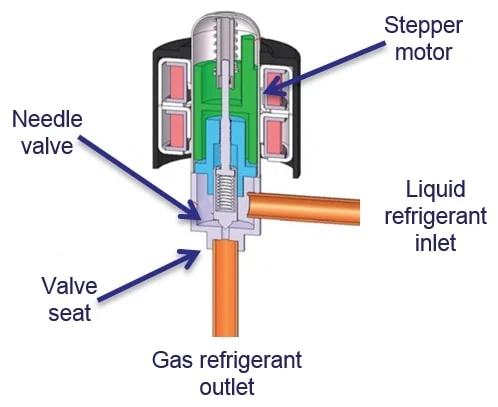
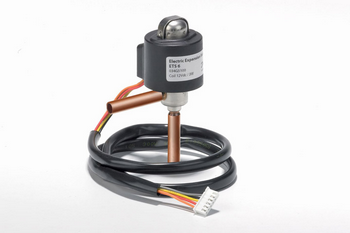
Electronic Expansion Valves (EXV) are modern, digitally controlled systems that allow continuous and precise regulation of refrigerant flow based on the actual needs of the system. They use electronic sensors and controllers to adjust the valve opening in real time.

Operating Principle:

•  The EXV is controlled by a microcontroller or digital control system, which receives data from temperature and pressure sensors, as well as other system parameters.
•  Refrigerant flow is continuously and dynamically regulated based on changing conditions, providing exceptional system operation precision and optimized efficiency.

Advantages:

1. Precision and Flexibility : The EXV can control refrigerant flow with exceptional accuracy, improving system performance under all conditions.
2. Dynamic Control : It can instantly adapt to changes in temperature, pressure, and other parameters, ensuring enhanced energy efficiency.
3. Energy Efficiency : Precise and continuous flow adjustment leads to significant energy savings, which is especially important for large installations or systems with variable demand.
4. Reduced Wear : Due to its accurate and controlled operation, wear on other system components (such as the compressor) is minimized, resulting in a longer service life.
Disadvantages:

1. Higher Installation Cost : The initial investment in an EXV is significantly higher due to the electronic technology and additional components (e.g., sensors and controllers).
2. Complex Maintenance : The need for specialized maintenance and system monitoring can be challenging, especially in areas with limited technical infrastructure.
3. Dependence on Electronic Systems : Operation relies on the electronic control system, which may be susceptible to malfunctions or interference.

Comparison: Which One to Choose?

Choosing a TXV:

•  Ideal for applications with lower performance requirements, where simplicity and reliability are more important than energy efficiency or precise control.
•  Suitable for systems with stable operating conditions, where dynamic adaptation to parameter changes is not required.

Choosing a EXV:

•  Ideal for systems that require high performance and dynamic adaptation to changes in temperature, pressure, or other parameters.
•  Suitable for applications with significant needs for energy savings, precise control, and high operational efficiency.

Conclusion:

The choice between an Electronic Expansion Valve (EXV) and a Mechanical Thermostatic Expansion Valve (TXV) depends on the specific requirements of the application. The TXV is suitable for applications with lower demands and limited budgets, while the EXV offers optimized energy efficiency and precision for systems with high performance and flexibility requirements.
Refrigeration Equipment & Spare Parts Trading
Monday - Friday: 08:00 - 16:00
Kerameon 17, 10436 Athens
+30 2105231126
+30 2105223039
 sales@hasioti.gr
Stay informed about our new products and our special offers
© 2024 Copyright - Unibyte All rights reserved.
apartment
linkedin facebook pinterest youtube rss twitter instagram facebook-blank rss-blank linkedin-blank pinterest youtube twitter instagram